

Can Type 2 diabetes lead to heart disease?
Diabetes and heart disease have a direct connection, with the diabetic up to four times more likely to die from heart attack. The good news? It’s manageable, even preventable. The impact of diabetes Many older adults struggle with diabetes, or linger at the tipping point between abnormally high blood sugar and a formal diagnosis. But what does it actually mean to someone with the disease, making it so important to conquer with better eating habits and physical activity? Diabetes can reduce the independence of an older adult, requiring lifestyle modifications to manage the disease. They’re suddenly at risk of complications and health risks of other conditions due to the vulnerabilities triggered by the diabetes. It can eventually lead to a need for full-time assisted living care, as the diabetes increasingly compromises the health of the diabetic. Already at a high risk from diabetes as the seventh leading cause of death, the diabetic is also far more vulnerable to the number one cause: heart disease. How diabetes leads to heart damage High blood sugar is a known risk factor of heart disease, just like smoking, obesity, high blood pressure and cholesterol increase the risk. It’s common knowledge. Because it increases fatty material inside of our blood vessels, the danger of blockage is increased, along with the risk of heart attack or stroke. The vessels also become stiff and hard, making it easier for the fats to stick to the walls of the blood vessels. When a fat deposit hits a curve on its way into the heart, it’s more likely to cause a pile-up of other deposits behind it, much like a car accident at a freeway stack. But there’s another risk most aren’t aware of. Because a diabetic has a higher level of glucose in their blood, the composition—the viscosity—of
Sun Health Can Help You Take Control of Your Health
If you’re struggling to lose weight and to feel healthier, we can help! Join Sun Health’s online Diabetes Prevention Program from anywhere. Your team of coaches include a certified lifestyle coach and registered dietitian. It may be covered by insurance. Next series starts 7/27 Participants from out of state welcome! Call 844-935-5377 or visit SunHealthDPP.org
Lower your A1c levels and get control of your Diabetes
If keeping your diabetes in check is one of your goals this summer, then we can help. Our Diabetes Self-Management Education (DSME) series is an evidence-based program designed to assist you in decreasing A1c levels, controlling blood pressure and cholesterol, and improving quality of life. This 5-week class series is accredited by the Association of Diabetes Care and Education Specialists and taught by a certified diabetes care and education specialist who is also a registered dietitian. 5-Week Series starting Thursday, May 27, 2021 from 2 to 4 p.m. Sun Health Center for Health & Wellbeing 14719 W. Grand Avenue in Surprise Call (623) 471-9355 to register. The cost of this program may be covered by most insurance plans. Please note: The health and safety of our staff and guests remain our top priority. We are limiting in-person classes to 15 people and conducting brief health screenings and temperature checks upon arrival. Face masks are required for everyone’s health and safety. Thank you.

Why Now is The Time to Talk to Your Adult Children About Alzheimer’s and Your Family History
The thought of memory loss and developing Alzheimer’s disease is frightening for anyone. However, Sun Health’s Memory Care Navigator program has good news to share. There are promising breakthroughs when it comes to treating those currently diagnosed, and there are significant advances toward preventing the onset of the brain disease for those who have a family history or may be at risk. Dr. Danielle Goldfarb, a neuropsychiatrist at the Banner Sun Health Research Institute, shares why she’s excited about the future for patients with memory care related issues. “There are so many things going on in the Alzheimer’s world and many investigational medications on the horizon that this feels like a more hopeful time than ever,” Dr. Goldfarb shares. Dr. Goldfarb says advances in the technology used for brain scans and spinal fluid testing can now detect the build-up of toxic proteins (known to cause the brain disease) years before symptoms set in. This means that, like many other diseases, we can now detect Alzheimer’s before it becomes life-altering. She says there are treatments shown in research studies to slow the progression of these toxic proteins. The key is knowing they exist. Additionally, Dr. Goldfarb shares there is promising new research on treatments to improve common Alzheimer’s symptoms of agitation and mood swings, which can be tough on the patient, and at times, unbearable for caregivers. She says Banner Sun Health is partnering with Johns Hopkins University to test a well-known, safe medication commonly prescribed for depression and anxiety, to help those symptoms in patients with Alzheimer’s. The study provides personalized patient and caregiver support along with the medication with the goal of improving agitation in patients with Alzheimer’s. “Treating these symptoms is important because the agitation and behavior changes can be more distressing to the patient and caregiver than

Could Robots Help With Loneliness?
Arizona State University is researching how social robotics can be used to assist older adults who are suffering from isolation and depression. ASU is asking for your participation with one of two surveys and your shared experiences will assist with a Ph.D. thesis study in the exciting field of social robotics. Participants will be entered into a raffle drawing for an opportunity to win a $25 Gift Card. Caregiver Isolation and Depression Survey If you are a caregiver for someone 65 and older who is experiencing isolation and or depression, ASU is asking for your help with a 10–30 minute survey. Participants must be 18 years and older to participate. The study is being conducted as an online survey and can be accessed with the following web address: https://forms.gle/mQ6SBy589t2EUTfU8 Older Adults Suffering from Isolation and Depression Survey If you are an older adult aged 65+ suffering from isolation and or depression, ASU is asking for your participation with a 10–30 minute survey. The study is being conducted as an online survey and can be accessed with the following web address: https://forms.gle/HQsGrfGWV8kbqPto7 The research team consists of the lead Principal Investigator (PI), Dr. Troy McDaniel of Arizona State University, and Ph.D. student Jordan Miller of Arizona State University. All questions can be directed to Dr. McDaniel at [email protected] or Jordan Miller at [email protected].

Why Taking A Deep Breath is Crucial When Hearing a Dementia Diagnosis
Relaxing is the hardest thing for anyone to do who has been diagnosed or is close to someone who has been told they have dementia (which is a decline in memory with the most common cause being Alzheimer’s disease). Sun Health’s experts in Memory Care will tell you that relaxation and using meditation techniques are crucial once you hear this kind of news. “People who are diagnosed with dementia often times have a significant increase in anxiety because of the fear and unknown of this potentially life-altering diagnosis,” says Barbara Mason, Vice President of Home and Community Based Services for Sun Health. “Having this diagnosis is sure to impact state of mind and mental health, so the sooner we can intervene to get the anxiety under control, the better.” And Ms. Mason shares you don’t need to be an expert to benefit right away. “Many of us grew up with the stigma behind taking medications for our mental health and that we should adopt the English, “stiff upper lip” attitude. This approach is much more private and holistic,” Ms. Mason shares. “It is simply learning to relax and using techniques to quiet the mind and body, which is so helpful when you have a new diagnosis like this. And the good news is you don’t have to be Buddha to use relaxation techniques.” Medical studies document the benefits of relieving anxiety in relation to slowing the progress of dementia. Ms. Mason also points out that relaxation and meditation are not just for the patient, but equally vital for the caregiver to use as well. “The anxiety and burnout and depression associated with being a caregiver is unbelievable. There are a lot of caregivers who live shorter lives than those with dementia,” Ms. Mason explains. “Meditation is a mental time out.

Sun Health is grateful to Season for Sharing and AZ Central
Sun Health is grateful to Season for Sharing and AZ Central for the $7,500 grant to support our Memory Care Navigator program, which is offered as community service to those in the West Valley. Every donation is critical to keep this program free for families caring for loved ones with dementia. Learn more with lead Memory Care Navigator Marty Finley.

Is it Normal Aging or Dementia?
Sun Health’s Memory Care Navigator shows us the difference between normal forgetfulness versus something being seriously wrong. As we all get older, we tend to worry about memory lapses. The added stress of the last year may have you wondering now more than ever if something is seriously wrong with your memory. Thankfully, as Sun Health’s Lead Memory Care Navigator Marty Finley, M. Ed. Explains, forgetfulness is not something to necessarily stress about. “Simple memory lapses, such as losing your keys or searching for that word you know is “right on the tip of your tongue,” can make us question whether it’s memory loss or something worse,” Finley says. “The stress of isolation and the whole world being different can exacerbate our ability to remember simple things. We know for a fact that the ability to remember does not work well under stress.” Finley reminds us that memory slips can be part of normal aging. However, when memory changes disrupt daily life, it may be something to be worried. Finley shares that some signs of Alzheimer’s or dementia include: losing track of the date and season, being unable to manage a budget, exhibiting poor judgement or having trouble with decision making, having difficulty maintaining a normal conversation, or misplacing things and not being able to retrace your steps to find the lost item. Finley further discusses this important topic in Sun Health’s popular presentation, “Normal Aging versus Dementia.” Sun Health’s next session of the informative class happens online at 9:30 a.m. on March 18. Those with questions can call 623-471-9355 or visit https://sunhealthwellness.org/class-calendar/ for the class link. And as a reminder Sun Health’s Memory Care Navigator program can help those with memory loss and their family members and friends to identify support, services and resources that may be helpful in navigating the dementia
Go Ahead, Eat That Burger or Chocolate
Surprise, Ariz. (January 14, 2021) – If your doctor has warned you that you are pre-diabetic, you might start mourning your favorite foods as while thinking about an unimaginable life without sugar in your diet. However, Sun Health’s Diabetes Prevention Program (DPP), one of a handful in Arizona with certification from the Centers for Medicare and Medicaid Services, has upcoming sessions that will get you back on the right track without feeling your life is getting derailed. It might be surprising that Sun Health’s program is not about taking away foods, but instead it teaches it’s ok to have that burger or candy as long as it’s part of a balanced diet. “I took Sun Health’s Diabetes Self-Management Class because I was having trouble controlling my sugar,” shares Sun City West resident Linda Keyes. “I didn’t expect to get a lot out of the class, but I’ve had diabetes for some years and I had trouble controlling my blood sugar.” And much to Linda’s surprise the guidance provided by Sun Health, worked. “My doctor had told me that I really need to work on reducing my A1c,” Linda says. “By the end of the class I was able to reduce my A1c from 7.2 to 6.3. I was thrilled, he was thrilled.” “What we want to help you do is create healthy habits, not restrictions,” says Teri Elkins, MPH, CHES, Health & Wellness coordinator and Diabetes Prevention Program coordinator for Sun Health. Those interested in losing weight while keeping diabetes from being a factor in their lives can register for the innovative sessions online https://sunhealthdpp.org/ or by calling (623) 471-9355. Registration for the January session closes on January 21 by there are also additional classes starting in February. Media interested in scheduling an interview with one of Sun Health’s Center
Important Message regarding the Center for Health & Wellbeing effective January 4, 2021
EFFECTIVE JANUARY 4, 2021 The Sun Health Center for Health & Wellbeing has temporarily suspended in-person visits and classes. We are committed to the health and safety of our community and will resume in-person offerings as soon as its safe with considerations to COVID-19. Please check for updates. We apologize for any inconvenience and will send out notices when in-person classes resume. Thank you for your understanding.

How to make the holidays more enjoyable for those with dementia
There’s something wonderful about the holidays. Friends and family gathered together, enjoying a tasty feast, bright lights and brightly wrapped gifts, often followed with lots of excitement. However, for those with dementia, Parkinson’s or another cognitive diagnosis, the holidays can be challenging. The stimulation is not always good for someone struggling with memory loss, but there are simple ways you can help your loved one experiencing memory loss have an enjoyable time. “Limiting your loved one’s exposure to holiday activities may help keep them from becoming overwhelmed,” according to Marty Finley, M.Ed., Sun Health’s Lead Memory Care Navigator “Consider keeping celebrations short, balanced by quiet time and a return to a normal routine. Afterward, turn off the music, close window blinds and shut off the tree lights. Limit holiday decorations to one room and keep their bedroom a holiday-free space.” Conversations in a noisy room also can be difficult. To keep interactions positive and reduce stress, make sure to have your loved one’s attention before speaking to them. Try speaking their name and making eye contact to help them follow along. Also, keep questions simple. The “Caregiver’s Guide to Understanding Dementia Behaviors” by the National Center on Caregiving suggests using the same wording when you repeat something, rather than rephrasing it. Adding visual cues or prompts can help. For example, when offering a choice of side dishes, try holding one up in each hand and pointing to it. Another key to success, help your loved one feel included. “Dementia can be isolating, especially when a loved one is confused by the festivities. To help them enjoy the celebration, take time to reminisce about the past,” Ms. Finley shares. “If they are able, try including them in simple tasks they can successfully manage. If they’re in later stages of dementia, try
Is it time to take the keys? Driving and dementia
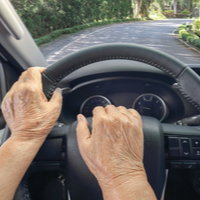
The road can be uncertain when your loved one is diagnosed with memory loss. Dementia, with the most common form being Alzheimer’s, is the general term used when memory loss, thinking, problem-solving deficits interfere with daily activities. One activity that needs to be monitored closely after a dementia diagnosis is driving. “It is normal as we age to have changes in our vision, hearing and flexibility. That is to be expected,” explains Marty Finley, M.Ed., Sun Health’s Lead Memory Care Navigator. “What is different when someone is diagnosed with dementia is the ability to concentrate on what they are doing and how to react appropriately.” Finley points out driving is a complex and complicated task, which requires the ability to focus, and simultaneously change our attention to surrounding variables at a moment’s notice. For example, a person could turn in front of you, prompting the need for a quick reaction and good decision-making ability to avoid a collision. “Families tend to think mom or dad are ok to drive because it’s only their short-term memory that is problematic” Ms. Finley says. “But what I teach is that the multiple brain changes that impact judgment and reasoning can cause someone to do things that are unsafe. Many other factors, such as Visuospatial ability, referring to a person’s ability to identify visual and spatial relationships among objects, can also impact the ability to drive safely.” Finley acknowledges that discussions around driving can be tricky and says signs that it “could be time” are things like unexplained dents or dings on the car – signaling that the individual is having difficulty navigating their vehicle and that skills such as parking or making turns have declined. “Sun Health works to educate and inform families so they have the facts so they can come to

Cognitive Decline Affects Everyone: Make a Resolution to Improve Your Outcome
Just about everyone will experience some sort of changes in their memory as they age. But, growing research shows that the brain doesn’t take one aging path. Instead, many criteria can influence how and why your brain ages. That means that occasionally losing your keys or forgetting what day it is doesn’t always indicate that you’re on the way to permanent cognitive decline. Memory and cognitive issues fall into three categories: Short-term memory lapses associated with normal aging Mild cognitive impairment (MCI), marked by more noticeable difficulties with memory and speech Dementia, which involves memory, language and cognition problems severe enough to interfere with everyday life It’s important to note that while the above are considered stages of cognitive decline, it’s not a foregone conclusion that everyone will go through each stage. In fact, four out of five older adults won’t ever experience anything more than temporary memory lapses or “senior moments”. 15 to 20 percent will progress to MCI, and no more than half of them will develop the most common form of dementia, Alzheimer’s disease. There’s no known way to reverse MCI, and there are currently no treatments or cures for Alzheimer’s disease. Increasingly, researchers are exploring ways that people can manage their risk of developing cognitive problems with lifestyle changes and healthy choices. That’s good news for those looking to reduce their risk of serious cognitive decline. More and more, we’re deepening our understanding of what we can do every day to protect our brains for years to come. We encourage you to make a resolution to keep your mind healthy and active in 2020 (and beyond) by following any of the tips in this article. Stay active Physical activity benefits the mind as much as the body. Studies have suggested that people who exercise often have

Subtle Signs and Risk Factors of Prediabetes You Shouldn’t Ignore
According to the CDC, 1 in 3 adults have prediabetes, yet 90 percent have no idea. With no intervention, many people with prediabetes will develop type 2 diabetes within 5 years, per the CDC. It’s possible to have prediabetes with no clear symptoms, making it hard to identify until type 2 diabetes develops. But, in many cases, you can recognize the warning signs and stop prediabetes in its tracks. It’s important to note that while the signs and risk factors in this article can point to prediabetes, every case is different. If you think you have prediabetes, contact your doctor for an accurate diagnosis. Skin discoloration Darkened or discolored skin on certain parts of the body typically occur in people who are obese or have diabetes, although obesity does not always mean a person has prediabetes. This is called acanthosis nigricans, and it commonly affects your neck, armpits, elbows, knees and knuckles. Acanthosis nigricans has been associated withnsulin resistance, a common symptom of diabetes caused by the body’s inability to remove glucose from the bloodstream. Along with being darker than usual, the affected skin may also feel leathery, or velvety, and develop an itch or smell. Numbness or tingling in hands, feet, fingers or toes Nerve pain, numbness and tingling in the extremities are common early signs of neuropathy. Your hands and feet may feel like they’re asleep, or you may notice a painful “pins and needles” sensation throughout your body. While it was previously believed that neuropathy only developed in type 2 diabetes, a growing body of research has linked neuropathy with prediabetes. One study followed 62 people over three years, and found that those with prediabetes developed nerve damage over the entire length of sensory nerve fibers. Because neuropathy can lead to irreparable nerve damage, early intervention is